

Soil is a living system, not an inert support. It feeds crops, stores water, and sustains the biological processes that make agriculture resilient. Among its essential nutrients, phosphorus plays a decisive role in root development, flowering, and overall productivity [1][2].
Yet phosphorus has a paradox: when it accumulates beyond what the soil can absorb, it becomes part of the problem rather than the solution. Excess fertilization, repeated cropping patterns, and weak nutrient monitoring can gradually degrade soil quality and increase pressure on water resources [3].
This article follows our previous exploration of phytoremediation for agricultural soil depollution [4] and extends the discussion to phosphorus management, soil recovery, and sustainable agronomic practices.
A Response to Farmers in Crises and Vulnerable Contexts
This article was first conceived as a response to farmers in contexts marked by crisis, conflict, and displacement. In many such regions, soils have been intensively farmed, poorly managed, or left without adequate monitoring, leading to nutrient imbalances and pollution risks.
Our goal is to address the specific challenges faced by these farmers, while also making the information useful for a broader audience. We want to ensure that those who cultivate land under difficult conditions – even without access to laboratories or advanced tools – can find practical guidance to restore soil health and protect water resources.
Why Excess Phosphorus Becomes a Problem
In balanced systems, phosphorus supports plant health. In overloaded systems, it destabilizes the soil.
The main causes are:
- Soil testing that is too rare or absent, which leads to fertilizer decisions based on assumptions.
- Repeated applications of phosphorus-rich fertilizers, which create nutrient accumulation over time.
- Monocropping, which weakens soil structure and increases reliance on external inputs.
- High-input or non-native crops, which often need more chemical support than locally adapted varieties.
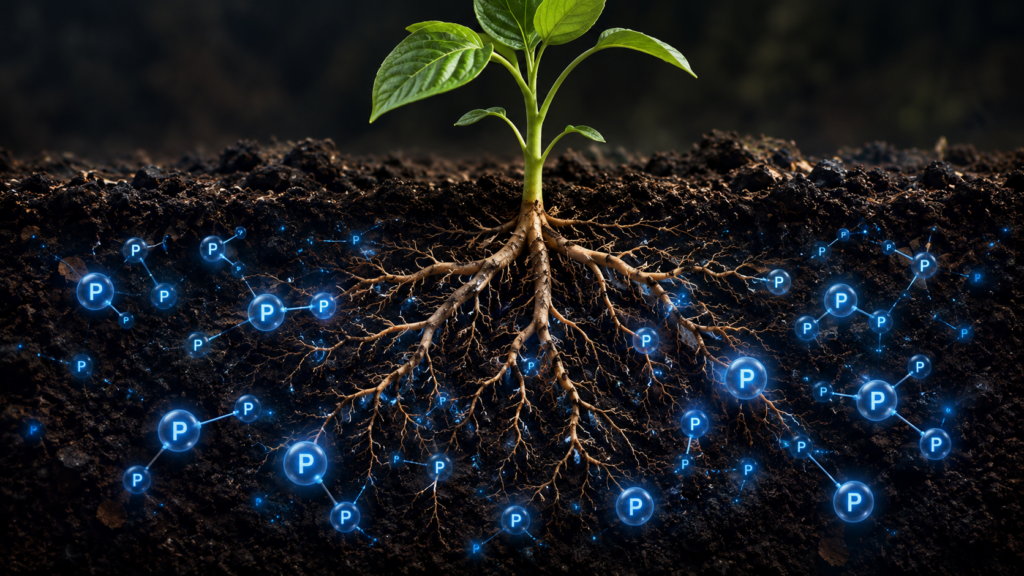
When phosphorus exceeds the soil’s capacity, rainfall and irrigation can move it toward waterways. The result is eutrophication, algal blooms, and oxygen depletion in aquatic ecosystems. In other words, soil imbalance quickly becomes a water quality issue. [3]
From Nutrient to Pollutant
Phosphorus is indispensable in small and controlled amounts. But when levels rise too high, the consequences extend beyond crop nutrition.
Excess phosphorus can disrupt nutrient cycling, reduce microbial activity, and weaken long-term soil fertility. It can also reinforce a cycle of dependency, where the response to declining soil function is even more fertilizer and pesticide use.
This is why phosphorus should not be treated as a narrow agronomic topic. It is also a territorial issue, because it connects soil management, water quality, and ecosystem health. [3]
Nature-Based Solutions for Soil Recovery
A sustainable response to excess phosphorus requires both prevention and remediation. The goal is not only to reduce surplus phosphorus, but also to restore the soil’s ability to function as a living, productive system over the long term.
A key scientific insight is that soils vary widely in their capacity to retain phosphorus, depending on texture, organic matter, clay minerals, and hydromorphic conditions. This means that understanding the phosphorus sorption properties of the soil is essential for designing effective restoration strategies. Without this understanding, even well-intentioned interventions – such as reduced fertilization or plant‑based remediation – may fail to address the actual risk of leaching and discharge into water bodies. [5]
Soil testing and monitoring
Regular soil analysis is the starting point for responsible fertilization and forms the backbone of any sustainable soil management plan. It helps identify the concentration of phosphorus and other nutrients, reveals potential imbalances, and avoids unnecessary inputs that can accumulate over time. In practice, this means testing not only before planting, but also at the end of the cropping cycle, in order to track changes in soil status. When combined with water quality monitoring, soil testing allows managers to connect field‑level decisions to watershed‑scale impacts and to adjust applications so that they match real soil needs, rather than assumptions or historical habits.
Phytoremediation
As discussed in our earlier article on phytoremediation for agricultural soil depollution, this approach uses specific plants to absorb, stabilize, or transform contaminants in soil. Certain species can take up excess phosphorus and store it in their biomass, while others help stabilize the element in less mobile forms through root interactions and microbial associations. [4][6]
In a broader restoration strategy, phytoremediation therefore complements other agronomic measures such as buffer strips, cover cropping, and drainage management. It is rarely a standalone solution, but it can play a valuable role in reducing the phosphorus load in sensitive zones or at the edges of agricultural landscapes. [7]
Organic amendments
Compost, manure, and other organic amendments improve soil structure by increasing aggregation, porosity, and water retention, which in turn enhances the soil’s ability to retain nutrients. Organic matter also feeds microbial communities involved in nutrient cycling, creating a more dynamic and resilient soil environment. When applied thoughtfully, these amendments can help buffer nutrient availability, reduce the risk of leaching, and support the gradual release of phosphorus in forms that plants can actually use.
In many cases, long‑term use of organic inputs even reduces the required doses of mineral fertilizers, leading to lower environmental pressure and lower costs over time.
Crop rotation and diversification
Crop rotation reduces the risk of nutrient depletion by varying the type and depth of root systems, the nutrient demand patterns, and the soil structure over time. It also limits pest and disease pressure, as continuous monoculture creates stable conditions for specific pathogens and insects.
Integrating legumes and other complementary crops diversifies the biological and mechanical roles performed by vegetation, from nitrogen fixation to weed suppression and phosphorus scavenging. This approach improves nutrient balance gradually and reduces dependence on synthetic fertilizers. It supports the long‑term recovery of soils that have been over‑fertilized or degraded by intensive management. [1]
Khawla’s Field Perspective
In my work managing farms and designing kitchen gardens in Lebanon and Saudi Arabia, one lesson is constant: soil health improves when management becomes strategic rather than reactive.

The most effective practices are often the simplest:
- Minimal soil disturbance to preserve structure and water retention.
- Structured crop rotation to distribute nutrient demand over time.
- Companion planting to support resilience and reduce pest pressure.
- Reduced chemical inputs to protect soil biology and limit contamination.
These practices do not work in isolation. Together, they form a practical framework for healthier crops, cleaner soil, and more efficient water use.
The Water–Soil–Plant Connection
Soil and water are inseparable. When phosphorus is over-applied on land, part of it can move into aquatic environments. And then, it can affect biodiversity, water quality, and ecosystem function.
This is why phosphorus management is not only a fertilization issue. It is also a water strategy, a soil strategy, and a sustainability strategy.
At Watnowa, this integrated vision is central. Our work connects the water–soil–plant continuum to help territories, organizations, and public actors move toward more sustainable resource management.
Conclusion
Healthy soil is not about adding more inputs. It is about understanding what the soil needs, reducing excess, and restoring balance.
Regular soil testing, diversified cropping systems, and nature-based remediation methods such as phytoremediation can help transform degraded soils into productive and resilient systems. For Watnowa, this is where environmental performance begins: in the balance between soil fertility, water quality, and plant health.
References
[1] FAO. Outils de gestion durable des terres. https://www.fao.org/soils-portal/soil-management/outils-de-gestion-durable-des-terres/fr/
[2] France Nature Environnement. Sols : enjeux et solutions en France. https://fne.asso.fr/dossiers/sols-enjeux-et-solutions-en-france
[3] OFB (2022). Phosphore : mieux gérer la ressource, mieux protéger les milieux aquatiques – état des lieux et perspectives. https://ofb.gouv.fr/doc/phosphore-mieux-gerer-la-ressource-mieux-proteger-les-milieux-aquatiques-etat-des-lieux-et
[4] Agbagla, N (2026). La Phytoremédiation : quand les plantes dépolluent nos sols pour une agriculture durable. https://watnowa.com/phytoremediation-depollution-sols-agricoles/
[5] Couic, E., Gruau, G., Gu, S., & Casquin, A. (2022). Variability of phosphorus sorption properties in hydromorphic soils: Consequences for P losses in agricultural landscapes. European Journal of Soil Science, 73(6).
[6] ADEME, INERIS, ISA-Lille, Mines Saint-Etienne (2017). Les phytotechnologies appliquées à la gestion des sites pollués. https://www.ineris.fr/sites/default/files/contribution/Documents/guidephyto2-mars2017-1496923668.pdf
[7] Caroline ROBIN, CEREMA, Nature 4 Cities. Gestion des zones polluées grâce aux plantes (phytoremediation). https://www.adaptation-changement-climatique.gouv.fr/sites/cracc/files/fichiers/2020/02/fr_Phytoremediation.pdf
Written by Khawla Seif – Agricultural consultant | Edited by Watnowa